BAD PHILOSOPHY
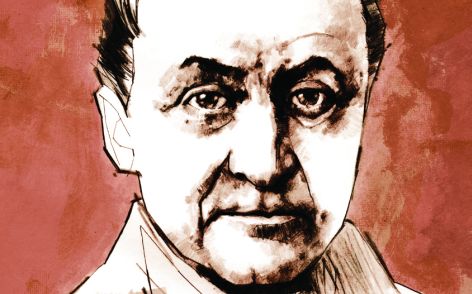
On the subject of stars, all investigations which are not ultimately reducible to simple visual observations are ... necessarily denied to us. While we can conceive of the possibility of determining their shapes, their sizes, and their motions, we shall never be able by any means to study their chemical composition or their mineralogical structure ... Our knowledge concerning their gaseous envelopes is necessarily limited to their existence, size ... and refractive power, we shall not at all be able to determine their chemical composition or even their density... I regard any notion concerning the true mean temperature of the various stars as forever denied to us.Here, Comte is assuming that the determination of composition, density, temperature, etc., would require one to obtain physical samples of the stars---obviously, a very difficult proposition even today.
 However, only 14 years later, the physicist
Gustav
Kirchhoff discovered that the temperature and chemical
composition of a gas could be deduced from its electromagnetic
spectrum viewed from an arbitrary distance.
This method was extended to astronomical bodies by
William
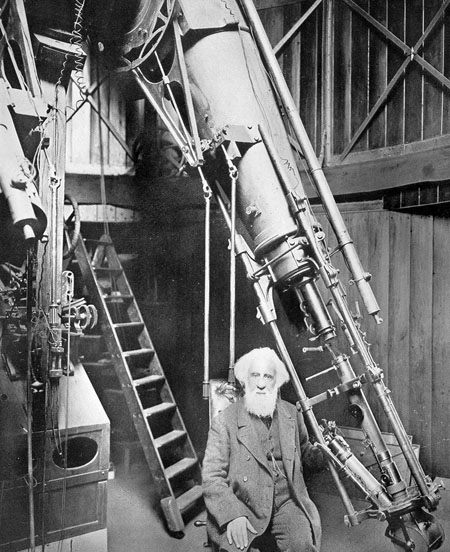
Huggins in 1864, who was the first to use a
a spectroscope
attached to a telescope. (See image at right.) Not only have we
learned how to determine the chemical composition of distant stars and
nebulae, but the element helium (the second most abundant in
the universe) was first identified in the spectrum of the Sun, rather
than in an earthbound laboratory.
Today we use spectroscopy to measure chemical abundances,
temperatures, velocities, rotations, ionization states, magnetic
fields, pressure, turbulence, density, and many other properties of
distant planets, stars, and galaxies. Some objects studied
this way are over 10 billion light years away. Spectroscopy is the
richest source of information about the universe. In its laboratory
setting, spectroscopy provided the experimental basis for
quantum
mechanics.
Two lessons: nature usually outstrips the human imagination.
And philosophers often get science wrong.
However, only 14 years later, the physicist
Gustav
Kirchhoff discovered that the temperature and chemical
composition of a gas could be deduced from its electromagnetic
spectrum viewed from an arbitrary distance.
This method was extended to astronomical bodies by
William
Huggins in 1864, who was the first to use a
a spectroscope
attached to a telescope. (See image at right.) Not only have we
learned how to determine the chemical composition of distant stars and
nebulae, but the element helium (the second most abundant in
the universe) was first identified in the spectrum of the Sun, rather
than in an earthbound laboratory.
Today we use spectroscopy to measure chemical abundances,
temperatures, velocities, rotations, ionization states, magnetic
fields, pressure, turbulence, density, and many other properties of
distant planets, stars, and galaxies. Some objects studied
this way are over 10 billion light years away. Spectroscopy is the
richest source of information about the universe. In its laboratory
setting, spectroscopy provided the experimental basis for
quantum
mechanics.
Two lessons: nature usually outstrips the human imagination.
And philosophers often get science wrong.
Web links:
-
More
about atomic structure & spectroscopy
Wikipedia Entry
for Comte
More about Kirchhoff
More about
Huggins
Philosophical criticisms of meaning and value in science have
waxed and waned over the last few hundred years. Particularly
acrimonious exchanges have taken place in the last thirty years. For
a sampling of the debate over a famous academic hoax in which a
physicist wrote a parody of a "post-modern" article critical of
science that was nonetheless published in a leading philosophical
journal, see:
Last modified December 2020 by rwo